Pump & Motor Repair Services
Mech Group offers comprehensive pump and motor repair services in Jeddah. It handles various pump and motor types to cater to industrial needs.

CONTRACT & SERVICING
Split Case Centrifugal Pump Maintenance: A No-Sweat Guide to Keeping Things Flowing. Let’s be honest: the term Split Case Centrifugal Pump Maintenance might not make your heart race with excitement. For many, it sounds like a complicated, oily chore best left to someone else. But what if I told you that understanding this process is like having a superpower? You can prevent catastrophic failures, save a ton of money, and be the workplace hero who kept the water (or whatever fluid) flowing. This guide, brought to you by your friends at Mech Group, will walk you through everything you need to know, without the confusing jargon. Think of it as pump maintenance, demystified!
Essentially, a Split Case Centrifugal Pump is a workhorse. It’s called “split case” because its casing can be literally split open horizontally, like opening a book, giving you easy access to the impeller and shaft without disturbing the piping. This brilliant design makes pump maintenance and service far less of a nightmare. Whether you’re dealing with a critical industrial system or a major municipal water supply project here in Water Pump Saudi Arabia, proper care of these units is non-negotiable. Ignoring it is like never changing your car’s oil – eventually, you’re stranded on the side of the road. So, grab your (metaphorical) toolbox, and let’s dive in step-by-step.
Before we get our hands dirty, it’s crucial to understand the “why.” Simply put, consistent pump maintenance is the cheapest insurance policy you’ll ever buy. A well-maintained Split Case Centrifugal Pump runs efficiently, uses less energy, and can last for decades. Conversely, neglect leads to inefficiency, sudden breakdowns, and costly emergency calls to maintenance companies or frantic searches for Pump repair services near me.
Furthermore, consider the domino effect of a pump failure. It’s not just one piece of equipment stopping; it can halt an entire production line, leave a building without water, or cause significant operational delays. Proactive pump maintenance and service is the art of replacing a $ seal on your schedule, rather than a $ impeller and shaft during a panic-stricken midnight shift. It’s the difference between being in control and being at the mercy of your machinery.
Alright, eager beaver, don’t just run at the pump with a wrench! Safety is the boring but absolutely essential opening act to any good maintenance show. First and foremost, lock out and tag out the power source. This isn’t a suggestion; it’s a life-saving rule. Ensure the pump is completely isolated from electrical or mechanical power. Next, isolate the pump from the system by closing the suction and discharge valves. Then, vent any pressure and drain the pump casing completely. Trust me, getting a surprise shower of industrial fluid is only funny in cartoons.
Once you’re sure the pump is de-energized and depressurized, gather your tools and documentation. Having the pump’s manual, a maintenance log, and the right tools at hand will make the process smoother. This is also the time to decide if this is an in-house job or if you need to call in professional Pump repair services. For complex issues or if you’re unsure, there’s no shame in contacting a reputable Pump Service Center like the experts you can find through Mech Group. Remember, a phone call for advice is free, but a mistake can be very expensive. You can always reach us at +966597747661 or info@mechgroup.org for guidance.
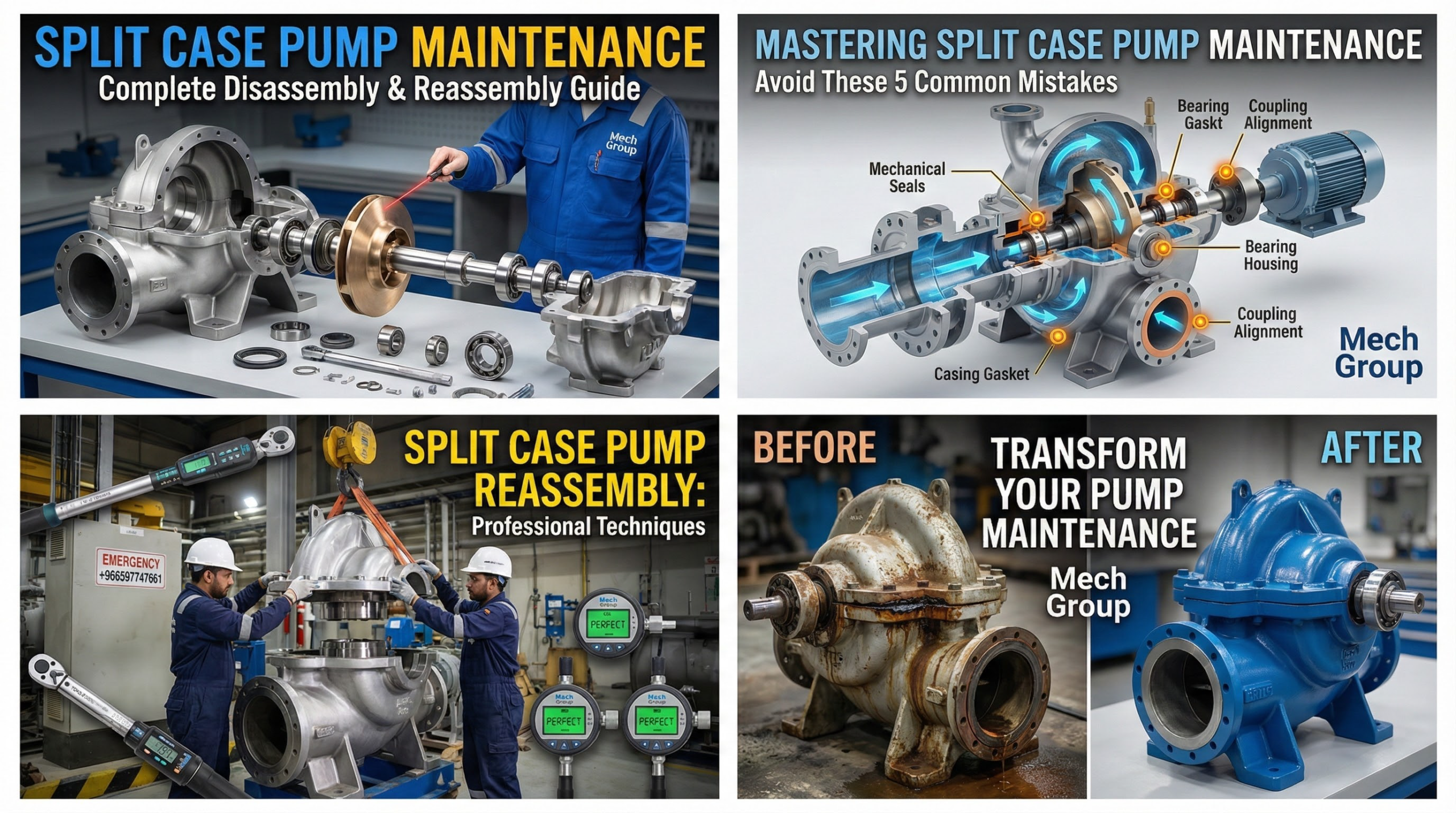
Now for the main event. We’ll break down the core process of Split Case Centrifugal Pump Maintenance. Follow these steps methodically.
The beauty of the Split Case Centrifugal Pump is right here in this step. After ensuring the unit is safe to work on, you can begin disassembly. Start by removing the coupling halves that connect the pump shaft to the motor. Then, unbolt and carefully lift off the upper half of the casing. Voilà! The pump’s inner world is revealed. This easy access is why these pumps are a favourite for systematic pump maintenance and service.
Upon opening, take a methodical look. This is your detective moment. Inspect the impeller for wear, erosion, or cavitation damage (which looks like someone took tiny bites out of it). Check the wear rings for their clearance; excessive clearance kills efficiency. Look at the shaft for any signs of scoring or wear at the packing or mechanical seal areas. Document everything you see with notes or photos. This record is gold for tracking wear over time and planning future parts orders from your Pump supplier near me.
With everything open, it’s cleaning time! Thoroughly clean all components, including both halves of the casing, the impeller, and the shaft. Remove all old gasket material meticulously. A clean surface is critical for a proper seal when you reassemble. This is also the point where you decide what needs to be swapped out. Think of it as a spa day for your pump, but with more degreaser.
Now, replace all worn components. This almost always includes the casing gasket and any O-rings. If the wear ring clearance is out of spec, replace it. If the mechanical seal is leaking or the packing is worn, install a new one. If you’re in Jeddah and need quality parts, finding a reliable Pump supplier in Jeddah is key to getting genuine, compatible components. Don’t cut corners here—using subpar parts is the fast track to a repeat pump repair job next month.
Cleaning done? New parts ready? Great! Now, carefully reassemble the pump. Place the new gasket on the lower casing. Gently lower the rotor assembly (shaft, impeller, etc.) into place. Then, position the upper casing half and bolt it down. Crucially, tighten the casing bolts in a crisscross, star-pattern sequence to ensure an even, leak-free seal. Do not just crank them down in a circle!
Once the pump is back together, the single most important step awaits: alignment. Misalignment between the pump and motor shaft is a leading cause of vibration, bearing failure, and seal problems. Use a dial indicator or laser alignment tool to meticulously align the coupling halves. This isn’t a “looks about right” step. Proper alignment is a precise science and is critical for long-term health. If this feels beyond your comfort zone, this is a perfect task for professional Water pump repair services.
You’re on the home stretch! Before you hit the power button, double-check that all bolts are tight, the coupling guard is reinstalled, and the area is clear. Then, very slowly and slightly open the suction valve to fill the pump casing with fluid, venting any air out of the system. This is called priming. A centrifugal pump must never run dry.
Now, with the discharge valve still closed (to minimize starting load), start the pump motor. Let it run for a brief moment, then gradually open the discharge valve. Monitor closely for unusual noise, vibration, or leaks. Check the pressure gauges against the pump’s performance curve. Once everything looks and sounds good, let it run under normal load and take final vibration and temperature readings. Log all these results in your maintenance record. Congratulations! You’ve successfully completed a thorough Split Case Centrifugal Pump Maintenance cycle.
Even with the best guide, sometimes you need a pro. There’s no trophy for struggling alone. If, during your inspection, you find severe shaft bending, major casing erosion, or complex bearing issues, it’s time to call in the cavalry. Major overhauls often require specialized tools, presses, and expertise that professional maintenance companies possess.
Moreover, if you don’t have the in-house manpower, time, or confidence, partnering with a reliable Pump Service Center is a smart business decision. They can perform the maintenance faster, often with a warranty on their work, and provide detailed reports. For those searching for Pump repair services or a trusted Pump supplier in Jeddah, Mech Group can connect you with top-tier providers. A quick call to +966597747661 can save weeks of downtime.
In the end, Split Case Centrifugal Pump Maintenance isn’t just a task; it’s a mindset of proactive care. By following these steps—safety, disassembly, inspection, cleaning, replacement, precise reassembly, and testing—you transform from a reactive fixer to a proactive asset manager. You ensure that the vital Split Case Centrifugal Pump units, especially in demanding environments like Water Pump Saudi Arabia, perform reliably day in and day out.
Remember, consistent care prevents most emergencies. Keep detailed logs, use quality parts from reputable suppliers, and don’t hesitate to seek expert help from Pump repair services when needed. Your pumps (and your wallet) will thank you. For more insights, parts, or service connections, visit Mech Group or drop us a line at info@mechgroup.org. Now go forth and keep things flowing smoothly
